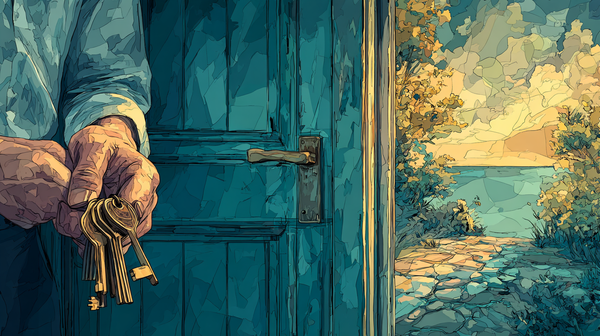
Post 5: Understanding Trauma Requires Pilgrimage
Wisdom cannot be summarized or downloaded. It can only be earned through the slow work of walking the territory yourself.


Quick Guide: Understanding Trauma Requires Pilgrimage
You've completed the foundation of Trauma Explained. Before you continue deeper into the full series, this post prepares you for what lies ahead.
What you'll learn:
- Why this work cannot be summarized or shortcut
- How wisdom develops through integration, not information alone
- The three converging truths that anchor all healing work
- What commitment the full pilgrimage requires of you
- How to choose your next path based on where you are
Read time: 20-24 minutes (reflective epilogue, moderate length)
Difficulty level: Medium — Conceptual and motivational rather than technical; explores why deep understanding matters
Content warning: This post discusses the scope and commitment required for healing. "The Real Commitment" and "The Benediction" sections may activate grief about time, capacity, or the magnitude of what trauma disrupts. These are normal responses. If you feel overwhelmed, use the Support Resources toggle.
Suggested stopping points: After "Why This Matters: Intelligence as Coordination" (you understand why pilgrimage cannot be rushed) or after "The Three Converging Truths" (you have full orientation to what you've learned). Or continue through "The Threshold" to understand your next choices.
What comes next: Series II: Architecture of Mind—posts exploring the neuroscience foundations of consciousness.
Support Resources: If You Need Them
This post is a transition epilogue that honors what you've learned and prepares you for deeper work ahead. It discusses the scope of healing and the commitment required—topics that can feel overwhelming or activate grief about time, capacity, or what you've survived.
Quick grounding (2 minutes):
- Notice your feet on the floor. Press them down gently.
- Take three longer exhales (breathe in normally, then exhale slowly for twice as long).
- Notice: You're here, now, safe in this moment.
If you need more grounding:
- Notice 5 things you can see
- 4 things you can touch or feel
- 3 things you can hear
- 2 things you can smell
- 1 thing you can taste
Most activating sections: "The Real Commitment" (scope of the full series) and "The Benediction" (vastness of healing journey) may trigger grief about time required, capacity you need to build, or losses you've experienced. These responses are understandable. Pause and ground if needed. This post isn't meant to overwhelm you—it's meant to honor the reality of what healing requires so you can choose your path consciously.
Purpose of this post: Not to pressure you, but to give you honest orientation. The pilgrimage should be walked at your own pace. There are no deadlines but your own.
Opening: What We've Just Accomplished
Pause for a moment and take a breath. Think about what has happened here.
Over the last four posts, you've learned something remarkable that maybe you've not seen before—a way of seeing trauma that casts it in a different light. You've learned to look at trauma not as simple damage or personal failure, but as comprehensible fragmentation. Something that makes sense. You've learned that healing isn't mysterious. That it follows predictable mechanisms. You've learned that your particular way of being stuck in trauma has a particular shape and pattern, and that you can use this shape as a map to better plot your course towards healing.
In my humble opinion, this is not trivial. With any luck, this new way of appreciating what trauma involves can become transformative for you.
If you're a trauma survivor, you've perhaps just moved from "something is wrong with me" to "here's how I'm stuck and here's which approaches address that particular stuckness." That's a profound and empowering shift.
If you support someone with trauma, you've perhaps moved from "I don't understand why they can't just..." to "I see the architecture of what they're navigating", opening the possibility for your more empathic understanding.
If you're a clinician, you've now glimpsed something your training has perhaps obscured: an integrated map that shows how the different therapeutic approaches you've studied (and some that you've not) actually work based on the same underlying principles, each accessing the underlying mechanisms of healing from different entry points.
You've brought your consciousness to consciousness. You've appreciated how awareness works and perhaps have seen your own patterns reflected back. That recursive capacity—to turn awareness on itself—is where healing begins.
And, consider this too: what you've learned so far is only prologue.
The real pilgrimage I'm hoping to guide you through is just now beginning.
My Motivation for This Work
Before we proceed, I want to tell you why I'm undertaking this vast project attempting to explain trauma. Why I've outlined 118 posts instead of a simplified self-help guide. Why I'm asking you to invest months or years in learning this material.
One of Carl Sagan's passages from The Demon-Haunted World: Science as a Candle in the Dark captures it:
"Not explaining science seems to me perverse. When you're in love, you want to tell the world." —
I'm simply fascinated by how consciousness actually works. In total and complete awe. Amazed by how fragmentation follows patterns rather than random chaos. How healing follows principles rather than luck. How understanding your own trauma at depth transforms it from "something's wrong with me" into "here's what happened and here's what integration requires."
I want to share it with you—fully—in all its complexity and beauty. Because it is beautiful but even more so because it is useful to know. Because it may help you make sense out of what otherwise would not make sense. What otherwise would simply leave you in lingering pain. My hope is that you will take this work and benefit from it and then pass it along to those who you meet who might also benefit from it. My hope is that through sharing this work you will better find a way to heal—yourself and others.
I was an assistant professor of clinical psychology for a brief while when I was a younger man. In those days I wanted to publish papers, win accolades from my peers and secure tenure. Now that I'm older and don't need tenure anymore the audience I want to reach has changed. I'm still as fascinated by ideas as I ever was but now I've more fully embraced a healing mission at the center of my meaning-making. I will die someday (I don't know when) and when that happens, I hope to die with a smile knowing that I helped some people.
The readers I imagine as I write this are people who've been told or who have come to understand they're broken, who have been told to "just get over it"; in so many different ways given explanations that don't match or dignify their lived experience. I imagine people who sense there's an architecture a pattern underneath their suffering but can't quite see it. I imagine people ready for understanding deep enough to change how they can see themselves.
For those readers, I cannot offer a diminished version. Those people need "the full catastrophe". They deserve the whole landscape.
Why This Matters: Intelligence as Coordination
But there's another reason this work needs to be in-depth. The real goal of this pilgrimage is not simply to give you information—it's to develop your judgment. It's to help you develop wisdom.
Here's another Carl Sagan quote (from Cosmos) that clarifies this point:
"Knowing a great deal is not the same as being smart; intelligence is not information alone but also judgment, the manner in which information is coordinated and used."
You could read 118 posts and walk away with facts about neuroscience or developmental psychology. You could have someone summarize them for you. You might accumulate a lot of knowledge this way, but that knowledge wouldn't necessarily be useful.
A collection of unrelated concepts won't develop your judgment or wisdom.
Wisdom doesn't come from accumulation. It comes from personal integration. And integration only happens when you do the slow and arduous work of walking through the evidence and the arguments yourself.
You cannot rush this. You cannot shortcut it. You cannot read a summary and arrive at wisdom.
Why? Because when someone else summarizes their integration for you, you receive their conclusion without doing the updating that constitutes learning. Your nervous system never encounters the prediction error that forces revision. Your arrest patterns aren't illuminated by your own recognition—they're described to you. You get the form of understanding without the substance.
That's foreclosure, not wisdom. And foreclosure—accepting conclusions without personal exploration, as described by psychologist James Marcia—is the opposite of the integration I'm hoping to offer.
Wisdom is something you must earn through the journey itself. There is no arriving at it without the walking.
If you move through this material with presence and reflection—if you spend time with each series before proceeding to the next, if you let each one build on the previous, if you pause and sit with what you're learning, if you let connections emerge—then something begins to happen.
You start to see how the mechanisms connect to the arrest patterns. You understand how the neuroscience explains the development. You grasp how the understanding of trauma illuminates what healing requires.
Gradually, piece by piece, foundation by foundation, you develop coordination.
Not just knowing what works, but understanding why and when and for whom. Not just collecting symptoms, but seeing the patterns. Not just recognizing fragmentation, but grasping the principles of integration that apply across every scale—neural, relational, developmental, social.
That coordination—built through the slow pilgrimage itself—is what transforms information into wisdom.
And wisdom is what allows you to navigate your own healing not as a passive recipient of treatment, but as someone who understands the territory well enough to choose which paths to take.
The journey itself is the teaching. There is no arriving at wisdom without the walking.
That's why the pilgrimage matters. That's why it must be slow.
The Three Converging Truths
Let me remind you what we've established, because these three threads run through everything that follows.
First Truth: Integration Is the Master Pattern of Health
Integration is the defining principle of healthy systems. It appears at every scale.
Neural integration: different brain regions coordinating while maintaining their distinct functions.
Relational integration: two people remaining separate while genuine connection happens.
Developmental integration: different capacities maturing in sync, supporting each other.
Consciousness integration: different layers of awareness coordinating—automatic, observed, reflected, meta-reflected, all working together.
The pattern is identical across every scale: Integration is coordinated functioning where different parts maintain their distinctness while working together in service of stability and coherence.
Fragmentation—uncoordinated functioning where parts operate independently—is the baseline state. When development toward integration is interrupted or prevented, fragmentation persists. This persistent fragmentation creates instability that tips toward dysregulation, disorder, and disease.
Trauma doesn't create new mechanisms. It disrupts this integration principle. Your nervous system fragments into reactive patterns that can't coordinate. Your consciousness compartmentalizes into dissociated pieces. Your identity splinters into conflicting versions. Your relationships become unsafe because the coordination required for genuine connection breaks down. Your development arrests because the different domains can't support each other.
And healing does one thing across all these scales: It rebuilds integration.
From your neurons to your relationships to your sense of self to the social systems you inhabit, the pattern is the same. Integration creates the stability that allows health to flourish. Fragmentation creates the instability and isolation that produces suffering.
Second Truth: Eight Mechanisms Underlie All Effective Healing
Every therapeutic approach that works for trauma healing—regardless of name, modality, or theoretical orientation—engages some combination of the same eight healing mechanisms:
- Mindfulness and Self-Leadership (observational capacity)
- Nervous System Regulation (flexible arousal)
- Secure Attachment (safety in relationship)
- Memory Processing (past becomes history)
- Embodied Integration (body completion and discharge)
- Emotional Regulation (feelings without overwhelm)
- Narrative Reconstruction (meaning-making and identity)
- Social Connection (witnessed experience, collective healing)
EMDR works because it processes memories and regulates the nervous system. IFS works because it builds secure attachment between parts and develops observational capacity. Somatic therapy works because it completes embodied responses and rebuilds nervous system flexibility. Cognitive therapy works because it updates predictions and builds narrative coherence. Community healing works because it provides witnessing and connection.
They're different paths up the same mountain.
The mountain represents integration. The summit looks the same regardless of which trail you take. But different people need different trails.
When you understand the eight mechanisms, you become able to ask a more precise question than "which therapy is best". Instead a new question emerges: Which mechanisms does this person most need, in what sequence, in which domains?
Third Truth: Trauma Arrests Your Development Unevenly
Trauma doesn't break you uniformly.
Your intellectual development might continue while your relational capacity freezes. Your body might hold tight in activation while your mind goes numb. You might be sophisticated at analyzing others' patterns while completely blind to your own.
This is asynchronous development—different capacities arrested at different layers in different domains.
There's liberation to be had in understanding this: the patterns are mappable. Your particular way of being stuck isn't random chaos. It isn't destiny. It isn't a permanent trait that defines you.
It's a map.
And maps are useful for navigation.
Consider the arrest pattern matrix from Post 4. Five layers of consciousness. Five domains of experience. Where they intersect is where you're stuck.
You don't need to understand why you're stuck at Layer 2 in the relational domain (though we'll explore that in later series). You need to know that if you're stuck there, then cognitive insight-work (Layer 3 thinking) won't help you yet. You'll want to build up your observational capacity in that domain, at that layer first.
The pattern points to the path.
Understanding your particular trauma arrest pattern means you can waste less time on interventions that don't match where you're actually stuck. This is precision. This is hope grounded in understanding.
What These Three Truths Converge On
First: Trauma is comprehensible. Healing is possible.
Not "healing is guaranteed." Healing requires work, time, resources, support. Some people get stuck. Some people hit plateaus that last years. Some people heal slowly, unevenly, with setbacks.
But the principle is clear: fragmentation follows patterns. Those patterns can be understood. And patterns that can be understood can be worked with and changed.
This appreciation is in opposite to the notion that "you're broken and there's something fundamentally wrong with you." It's "here's how you're fragmented, here's why fragmentation happened, here's what integration requires, and here's the evidence that it's possible."
That shift—from mystery and shame to comprehensibility and hope—is itself the beginning of healing.
Second: all of it—every mechanism, every framework, every principle of integration—ultimately serves one purpose:
To rebuild your capacity for secure attachment to yourself and to others.
That's the draw. That's the goal. That's what makes the journey worthwhile.
Because trauma doesn't just damage your nervous system or arrest your development or fragment your consciousness. It severs connection—to others, to yourself, to the possibility of being genuinely known and loved.
And healing centers on the reconstruction of that connection. Not the erasure of what happened. Not the return to innocence. But the restoration of the capacity to say: "I can be known. I am worthy of connection. I matter."
Everything that follows serves that end.
From The Overview To The Path
You now have the frame. Everything described in Posts 1-4 is true, but it's the 10,000-foot view—the scenic overlook you can see from the mountain's peak. And it's not your view of that landscape; it's mine. I'm showing you my travel photos.
My goal is to motivate you to want to go there yourself, not to be satisfied with photographs, no matter how high resolution. Your own eyes are needed for this task. What if the journey itself helps you heal? What if you end up seeing something I missed?
Ordinarily, you'd have to walk the entire path to arrive at that view. But I've reversed the order for pedagogical reasons: you're more likely to see the value of the journey if you glimpse the destination first. I showed you the overlook so you could orient yourself before the walking begins.
Now the path opens up.
There are roughly 114 posts ahead, organized into 9 more series for a total of 10. All grouped into a single three-act structure that spans the entire project. This will be a pilgrimage—a marathon, not a sprint.
PART 1: FOUNDATION (Series I-III) — How integrated consciousness works
PART 2: DESCENT (Series IV-VII) — How trauma disrupts that integration
PART 3: ASCENT (Series VIII-X) — How healing restores it
These are the three stages of the pilgrimage. Each required. Each necessary if you're to truly understand the one that follows.
The Three Acts of the Pilgrimage
Part 1: Foundation (Series I-III) — Preparation and Orientation
You're almost done with Series I. When you finish this post, you'll have the trail map—the essential orientation before undertaking the journey.
Series II: Architecture of Mind will take you on a historical journey through neuroscience. I'll start with evolutionary foundations—why your brain has the layered architecture it does. I'll trace how emotional systems evolved. Together, we'll explore how the brain generates predictions and how precision-weighting guides attention. I'll show you how memory systems work, how embodiment grounds cognition, and how neural integration creates coherent consciousness.
None of this will be pop psychology. I'm going to give you the real neuroscience, explained without jargon but with full intellectual rigor. By the end, you'll understand why your nervous system responds the way it does. Why hypervigilance is so compelling. Why dissociation happens. Why flashbacks intrude without your permission. I'll show you why these phenomena do not indicate you're broken but rather that your nervous system is working as 'designed' by intelligently adapting to overwhelming stress.
Series III: The Developing Self will trace the same historical arc, but through developmental psychology. I'll follow how our understanding of development evolved from Piaget through Bowlby to Kegan and beyond—each researcher building on and deepening what came before. From that evolution of thought, the key questions emerge: How does consciousness actually develop from infancy into adulthood? What capacities unfold when? What are the critical windows? How does secure attachment literally build neural circuits? How do different developmental domains unfold—emotional, cognitive, relational, somatic, identity?
I'll then show what happens when development occurs within traumatic environments. How complexity arrests. How different capacities mature at different rates, creating the asynchronous profiles we mapped in Post 4.
By the end of Part 1, you'll understand not just what healthy integration looks like, but how it gets built. You'll have the necessary blueprints for understanding the territory ahead.
Part 2: Descent (Series IV-VII) — The Hard Passage
Then we turn toward difficulty.
This is the pilgrimage's central passage—the part that will require courage and steadiness.
Part 2 involves a descent because we're moving into territory that shows fragmentation—how things break under trauma—at every scale from neural systems to entire societies. It is also a descent into difficult and painful material showing the reality of how harm takes place. I will provide trigger warnings for heavy content appropriately.
Though the experience may be grim in moments, the purpose is clear: to clarify the architecture of trauma so you can recognize it, make sense of your own experience, and know you're not crazy for how you responded. Because integration requires understanding. You can't heal what remains invisible.
Series IV: The Nature of Trauma will zoom into what happens when overwhelm exceeds capacity. I'll trace how trauma manifests through neural systems, through prediction failures, through the specific ways simple and complex trauma create distinct disruptions.
Series V: Dissociation will explore what happens when the brain's response to unbearable experience is to fragment consciousness itself. I'll help you understand what dissociation is, not as symptom list, but as an intelligent, adaptive response to impossible circumstances. You'll learn how the brain compartmentalizes and what 'parts' actually are—why they feel like separate entities.
Series VI: Architecture of Abuse will examine how systems of harm operate. Not just what abuse does to a person, but how abusive systems are structured—how they use intermittent reinforcement, distort reality, create trauma bonds, and operate at individual, family, organizational, and societal scales.
Series VI is where you'll encounter the most difficult content. You'll learn the mechanics of abuse—how abusers actually operate. My purpose in showing you this is to illuminate, not to corrupt. I'll present this material unflinchingly, but never gratuitously.
Understanding how abusive systems work removes shame. It helps you recognize abuse when it happens and defend yourself. For survivors, it offers something essential: It wasn't random. You're not crazy. You responded normally to abnormal circumstances.
Series VII: Collective Trauma shifts focus to how trauma scales. How it operates across groups, generations, and societies. I'll help you understand how systemic oppression traumatizes and how historical atrocities reverberate through communities and generations.
Part 3: Ascent (Series VIII-X) — Return and Transformation
Having completed the Hard Passage, we'll turn back toward healing and integration.
Series VIII: Core Mechanisms of Healing will take those eight mechanisms and explain them in detail—grounded in neuroscience, developmental theory, and clinical evidence. How does mindfulness actually change neural patterns? How does nervous system regulation rebuild flexibility? How does secure attachment enable other healing? How does memory reconsolidation work neurologically? How does embodied completion discharge activation? How does emotional regulation develop? How does narrative reconstruction integrate fragmented identity? How does social connection facilitate collective healing?
By the end, you won't just understand what healing mechanisms exist. You'll understand how they work at neural, psychological, developmental, and relational levels. You'll see that while mindfulness must come first (you can't change what you can't observe), secure attachment is what makes all the other mechanisms possible—it's the relational foundation that allows healing to happen.
Series IX: Pathways to Healing will translate understanding of the essential healing mechanisms into actual therapeutic approaches. I'll survey specific contemporary therapeutic modalities—EMDR, IFS, somatic therapy, cognitive therapy, psychodynamic approaches, contemplative practices, community healing—and show how each evokes the healing mechanisms we've explored. We'll discuss how to match your arrest pattern to the approaches most likely to help you, and how to sequence your therapeutic work so you're building capacity in the right order.
This is where theoretical understanding becomes practical guidance.
Series X: The Bigger Picture will explore what becomes possible when you accomplish the healing work. I'll discuss post-traumatic growth, prevention, collective transformation, and offer a vision for a trauma-informed society where the disaster of traumatization could be minimized. Hope grounded in evidence.
Part 3 is an ascent because you'll be moving toward possibility. Toward understanding what integration makes available that fragmentation prevented. Toward recognizing that healing is more than just symptom reduction, but instead involves your resumed development toward authentic selfhood, genuine connection, and meaningful contribution.
The Real Commitment
This will not be a quick read.
This is not a self-help book you'll read in a weekend. It's an education program that will require patience, attention, and willingness to sit with complexity.
You've now spent however long it took to work through Posts 1-5. We have 114 posts ahead—roughly 25 times more content. Reading 3-4 substantial posts per week, you're looking at 6-9 months of sustained engagement. For the thorough path, 12-18 months.
You'll be committing to an intellectual and emotional journey that will require you to tolerate abstract concepts, sit with difficult truths about how harm operates, build your capacity to think in systems, and do the slow work of achieving deep understanding.
But here's what you'll gain:
By the end, you'll understand trauma at clinical depth. You won't just know your symptoms—you'll understand them as comprehensible responses to your history. You'll know which healing approaches address which aspects of fragmentation. You'll have a map.
And you'll know something essential: Healing is possible. It's not quick. It's not easy. But it's possible.
More importantly, you'll understand that healing is fundamentally about rebuilt connection—to yourself, to others, to the possibility of being genuinely known and still accepted. That's what all the mechanisms serve. That's the true destination of the pilgrimage.
The Threshold
Next comes the real work—walking the territory itself.
Three choices await you:
- Continue sequentially into Series II. You're ready for the deeper dive into neuroscience. You have time and capacity. You want to understand the complete architecture from foundation onward.
- Choose your own path using the reading paths from Post 4. You know what you need now. Trust that instinct. Jump to the series most relevant (provided it is completed and available at the time you read this). Use the cross-references below to connect concepts. Build understanding at your own pace.
- Pause and return later. You've absorbed a lot. Let it settle. You can come back to Series II later when you have more time, more capacity, or when something you're experiencing makes the deeper understanding feel urgent. This work isn't going anywhere.
These are all good choices.
Proceed however you best see fit. There's no timeline but your own. There's no test you need to sit for. There's no "right way" except the way that matches where you are. The only pressure I hope you feel is that which best serves your healing.
A pilgrimage shouldn't be rushed. It's walked at the pace of the pilgrim's own capacity and need.
The Benediction
As you prepare to embark on this pilgrimage, I want to leave you with a final quote:
"For small creatures such as we, the vastness is bearable only through love."
Carl Sagan wrote that in Contact, speaking about how human beings navigate the incomprehensible scale of the cosmos. It applies equally here.
The vastness of what you've survived. The vastness of fragmentation you carry. The vastness of the healing journey ahead. The vastness of understanding consciousness, development, trauma, and healing at the depth this series requires.
All of it is bearable.
Not because it's small or manageable or simple.
But because it is navigable with love—love of knowledge, love of understanding, love of yourself enough to undertake this pilgrimage, love of others who walk similar paths, love of the possibility that connection can be rebuilt.
Cross-References
Back to Post 1: Every Human Being Is Born Seeking Connection - Integration as the foundational principle that underlies all healing work
Back to Post 2: Trauma is Overwhelm, Not Violence - The distinction between simple and complex trauma, and how overwhelm relates to incompressible experience
Back to Post 3: Trauma Healing Unfolds Through Eight Mechanisms - The eight mechanisms you now understand operate through restored connection at different levels
Back to Post 4: Trauma Fragments the Mind Into Mappable Patterns - Your arrest pattern as the personal map that shows you where to direct your healing work
Forward to Series II: Architecture of Mind - Posts 6-14 take you deep into the neuroscience of how consciousness is built at the neural level, showing why integration matters biologically
Forward to the Full Journey - Part 1 Foundation (Series I-III) establishes what healthy integration looks like. Part 2 Descent (Series IV-VII) explores how trauma disrupts integration. Part 3 Ascent (Series VIII-X) shows how healing restores integration.