Post 7: The Firmware of Feeling
Your emotions are ancient survival programs comprising the firmware of feeling. Seven parallel systems in competition, each its own circuit, with unique triggers and purpose.


Series II — Architecture of Mind
Quick Guide: What You're About to Read
What you're about to read: An introduction to seven independent emotional systems that run through your nervous system, and why you can feel completely opposite things about the same person and still be you.
You'll learn:
- What Jaak Panksepp discovered about emotional systems in the brain
- The seven systems: what each does, where it lives, why it evolved
- Why emotional knowledge accessible one moment becomes inaccessible the next
- How these systems work together and work against each other
- Why some emotional oscillation is dysfunction, and why some is healing
Read time: 70-90 minutes | 25-30 minutes for core concepts (through the seven systems)
Difficulty: Medium — neuroscience explained through story and metaphor
Content warnings: This post includes a detailed description of emotional abuse in an intimate relationship (manipulation, sleep deprivation, interrogation as control). The description is clinical, not graphic, but if abuse narratives are difficult for you, you can skip the opening story and start at "The Spending Cycle" without losing the thread.
Stopping points (choose your own depth):
- After "How Did He Figure This Out?" for foundational concepts
- After the seven systems for complete architecture
- After the spectrum section for self-assessment
- After "Returning to Our Three" for full analysis
What comes next: Post 8 explores social emotions (shame, guilt, pride) layered on top of these seven systems, and how trauma disrupts that development.
Support Resources: If You Need Them
Before you read: Notice your feet on the floor. Take three breaths where the exhale is longer than the inhale. Feel that rhythm? That's your brainstem keeping time. It has been doing this since before you were born. It will keep doing it while you read.
If you feel flooded at any point:
- Step away without guilt
- Use grounding: 5 things you see, 4 you can touch, 3 you hear, 2 you smell, 1 you taste
- Return to the Quick Guide and reorient to where you are
- The work of this post is to give you a map, not to harm you
This post is designed to help you understand yourself, not to activate or disturb you. The clinical illustrations show everyday emotional switching. None are violent or graphic.
OPENING: THREE STORIES
Story One: The Abused Woman and her Husband
I knew a bright, educated and very capable woman a few years ago who came to talk to me in the midst of marriage problems. Her husband had fallen into an angry depression, had stopped working and had taken to drinking, leaving her to work and raise their children by herself. Some evenings when he was particularly upset he would torture her, subjecting her to what were essentially multi-hour tirade-style interrogations during which she was deprived of sleep. She was of course pretty angry and frustrated with this treatment but seemed held in place by a combination of guilt and fear: guilt from feeling she had made a commitment to this man who was the father of her children and owed him something as his wife, and fear that he would legally and otherwise attack her if she tried to leave him.
As I got to know this woman and her difficult situation better, I recognized she tended to experience a predictable cycle of emotional states. Under the influence of her husband's interrogations something would shift inside her, such that she started to see his interpretation of their circumstances as correct. In this version of events he was her victim, she had done him wrong based on past decisions she had made and she owed him a debt that could only be paid back by submitting to him, and taking care of his needs, as well as doing the lion's share of parenting while working her full time job and hoping that it would be enough. From this state she would experience terrible guilt for her failures as a wife, emerging from interrogations determined to do better. In those moments she believed this was the right and correct way to conduct herself, her submissive, apologetic stance feeling like clarity.
And then a few days might pass and she would find herself at work, or folding laundry, or driving home, and a thought would arrive: He got me again. Suddenly a new clarity would appear in her mind which replaced the earlier clarity: in fact she was a victim of his controlling and abusive behavior, her situation was very much unfair and unbalanced, and she would be foolish to continue tolerating it. From this perspective she would feel angry at the unfairness of it all. The way he would continue to escalate until she submitted. Her tremendous exhaustion from carrying the entire household while he remained unaccountable. While some of the anger she experienced was directed towards her husband, she reserved a not-inconsiderable portion of it for herself: her own tendency to take on her husband's entitled interpretations of what their marriage was supposed to look like as though they were facts, as though his emotional state was her responsibility to manage. She felt furious at the situation and at herself for having been "taken in" once again.
And for a while, under the influence of her anger, and in the presence of her fear of what he might do if she tried to leave him, she attempted to maintain her own version of reality such as it was, alternating between real thoughts of escape and not daring to try to escape because the cost would be too high.
And eventually there would be another major conflict, he would interrogate her again and the cycle would repeat.
Having read the above, you've probably figured out that this woman was being abused by her husband. And this was very much the case. His pattern of behavior towards her followed the classic template of abusive control: isolation, sleep deprivation, interrogation, emotional manipulation, threats of escalation if she attempts to escape. There's vital knowledge to gain about abusive control and how it works, but this isn't the right place for it yet; I'll return to it in future posts. What I want to focus on now is the cyclical pattern of motivational ambivalence in her experience. It is this cycling between contradictory realities, this switching between incompatible versions of truth, that I want you to notice. Such cycling becomes particularly prominent under abusive conditions, but it is its own phenomenon, separate from abuse, and not in any way unique to intimate relationships.
Story Two: The Spending Cycle
Here's a very different example of the same cyclical motivational ambivalence with a different origin. Another man I worked with was diagnosed with a bipolar mood cycling disorder. Periodically, when his mood would trend upwards, he would find himself becoming excited and engaged to the point of hyper-focus with whatever he was interested in that moment. His mounting excitement was the constant thread, not whatever activity it happened to be fixed on: photography, woodworking, music production, car modifications. In those moments of excitement, he would buy high quality, expensive gear, and quite a lot of it.
While perusing the websites selling this gear, this man would become fully immersed in the sense that this was the moment he had waited for. Each purchase felt exciting and correct, even the ones that some sense of him registered as speculative rather than core to his ambition. He imagined himself playing with the new gear to create something marvelous even as he purchased it.
A few weeks would pass, and the packages would start to arrive. And the credit card bill would appear, frequently larger than his bank account. By this time his mood had flagged, becoming less energetic and more depressed. His excitement had faded, and he no longer understood how he could have thought that all of this stuff was needed. He felt terrible about it, upset with himself that he did it again, bought too much of something he didn't need, putting himself into significant debt in the process. He couldn't understand how he could have allowed this to happen again. He would vow to do better in the future, in the moment completely sincere.
And, later still, there would be some new excitement he discovered. His hard-won knowledge unable to stick even though his debt very much did. New gear called out to him again, and he would again fall under its spell. If he had any awareness that he was once again in the danger zone, he couldn't seem to use it to stop himself from repeating the harm.
Story Three: The Angry Driver
Here is another different example of the same cyclical motivational ambivalence phenomena. This man came to work with me after having gotten into a physical fight with legal consequences. His attorney prompted him to work with a therapist because it would go better for him in court if they could say he had voluntarily appreciated the need to start anger management therapy.
In my office we talked about how it is that he finds himself in fights. He is sheepish and embarrassed talking with me. He explains this has been a repeating pattern in his life, which most often happens when he is driving. Someone cuts him off, didn't signal or otherwise behaves selfishly and he snaps, becoming very focused on the injustice of the situation, experiencing himself suddenly angry and thinking the other driver needs to be "taught a lesson."
I see the heat returning to his body in this moment of story-telling. For a moment, he becomes noticeably restless, his voice rising in protest, "They were driving like an idiot!", and then his crest falls and he is once again sheepish and embarrassed. He realizes he lost control and now has unpleasant consequences to face. He vows to do better next time. In this moment, the insight he experiences, the determination to do better, both feel solid and real. And as with the earlier two stories, this solid and real determination fell away as he would repeat the cycle, again almost getting himself into trouble while driving, experiencing the flush of rage and later the embarrassment of realizing he was not easily able to control himself no matter how much he wanted to.
This man's knowledge of his anger problem and how much he could benefit from learning how to restrain his angry impulses was and continues to be quite real. However, it might accurately be said that it is only accessible to him when he isn't angry. Once something triggers his anger, something shifts and his restraint is no longer there.
The abused woman in a relationship built on control and fear. The man with bipolar disorder caught up in cycles of mood-driven spending. The man whose anger repeatedly overrides his knowledge and intention. Three different people in entirely different circumstances, all however experiencing the same troubling cyclically ambivalent motivational pattern. What causes this to happen?
Let's you and I go deeper than blaming people for this. Something about how the nervous system is organized gives rise to cyclical ambivalence: something that explains why a person can know what they want to do, commit to it sincerely, feel clarity about it, and find all of that resolve gone in the moment it most matters. Why can someone oscillate between contradictory understandings of the same reality, each end of the ambivalence feeling absolutely true while active? Why can intelligent, self-aware people find themselves repeatedly trapped in patterns they recognize at least some of the time and desperately want to change?
THE MYSTERY STATED
What, exactly, is happening? What mechanism in the brain produces this motivational oscillation? Why does knowledge that feels solid in one moment become inaccessible in another? Why do these systems activate and deactivate in ways that seem to override intention and awareness?
The answers come from neuroscience. Specifically, they come from the work of Jaak Panksepp, a neuroscientist who spent his career mapping the emotional systems of the brain and showing how they work, independently and in coordination with each other.
The explanation is that you don't have a single emotional motivation system. You have a collection of seven of them. The moment you understand how these emotional systems work, the strangeness of these stories dissolves.
JAAK PANKSEPP'S CENTRAL CLAIM
The culmination of neuroscientist Jaak Panksepp's decades of scientific work was his description of seven independent emotional systems that underlie motivation in mammalian species.
Seven systems, each with its own neural circuitry, neurochemistry, and signature of behaviors, thoughts, feelings, and bodily changes. Each one evolved to solve a specific survival problem. These aren't theoretical constructs. Each has a physically distinct substrate in the brain.
What's more, the seven systems can function in parallel, able to activate independently to different degrees simultaneously. What we call "mood" is the product of some or all of them operating at once. And critically: each emotion system can suppress or amplify the activation of the others.
The interaction, inhibition, and amplification among these seven systems is what makes those opening stories suddenly intelligible. And what makes your own ambivalence comprehensible.
Panksepp's emotional systems are not learned but are instead built-in to the structure of your brain as it forms. They are biological and instinctual structures. Cultural constructs influence how people experience and express them, but they do not determine them. These emotion systems exist in all mammals. They are the ancient firmware of the mammalian brain.
Metaphorically, each emotional system is like a musician in an orchestra. Each has its own instrument, its own voice, its own logic. Each can play alone or with others. Sometimes they harmonize. Sometimes they compete. The music that we call our emotional lives emerges from how these systems play or do not play together.
THREE WORDS YOU'LL HEAR: AFFECT, DRIVE, AND EMOTION
Before I describe the systems themselves, you'll need clarity on three terms that get used loosely and often interchangeably.
Affect refers to the raw neurobiological response that produces emotion. It's subcortical, largely automatic, and happens much faster than conscious thought. Affective systems have their effect on you before you even recognize what is happening, organizing your body and attention before your conscious awareness that something has changed arrives.
Drive refers to the internal pressure you experience that motivates you towards a goal. Hunger drives you to seek food, thirst drives you to water, and lust drives you toward sex and reproduction. Drives ramp up in pressure and intensity until you satisfy the need they represent, then subside. They function homeostatically: they are a way that your organism motivates you to maintain its balance.
Finally, Emotion refers to the conscious experience of affect combined with action. What you might call anger, sadness or joy are all examples of felt emotion, which comprises both how you feel and how you act it out; what you do about it.
Panksepp's Innovation Stated Explicitly
Throughout the twentieth century, competing theories proposed different answers to how emotion and motivation work. Sigmund Freud argued that unconscious drives motivated behavior. Silvan Tomkins countered that feeling, not drive reduction, was primary. Paul Ekman tested Tomkins' ideas empirically, finding that emotional expressions were universal across cultures. What Panksepp did was unify all these perspectives and ground them in actual neuroscience.
By the end of his career, Panksepp had identified and mapped seven independent emotional systems: ancient, built-in subcortical circuits that exist in all mammals. These systems generate affects that cause you to feel something, and that feeling is what moves you: to address bodily needs, toward social connection, away from threat or toward confrontation. Most critically, the seven systems operate independently while influencing each other, able to activate simultaneously at different intensities and to suppress or amplify one another.
(For the full intellectual lineage—how Tomkins led to Ekman led to Panksepp—see Appendix A. That history is fascinating, but understanding the systems themselves is what matters now.)
HOW DID HE FIGURE THIS OUT?
Panksepp didn't theorize. He went to the lab and did the detective work.
His primary tool was electrical stimulation: stimulate a brain region and watch what happens. Stimulate one region and the animal seeks food, explores, shows curiosity. Stimulate another and you see rage, aggression, threat displays and dominance behavior. These responses were consistent and specific enough for Panksepp to attribute causality.
But he didn't stop there. He stained and examined brain tissue under the microscope, mapping neuronal structures and connections. He analyzed neurochemistry to identify which neurotransmitters were present in which regions. He performed lesion studies to see what happened when brain structures were damaged. He used drugs to activate or block neural pathways. He recorded neural activity directly, watching how neurons fired in response to emotional states.
And he compared all of this across species: rats, mice, cats, primates. If an emotion system showed up in all of them, he concluded it was ancient and fundamental.
What emerged from this approach was not just the location of emotion systems in the brain but how each mechanism worked: what cells it contained, what connections it maintained, which chemicals it used, what happened when it was stimulated.
That slow, systematic, repetitive work is how scientific credibility actually gets built. Not a single brilliant insight, but dozens of carefully measured observations converging from different angles, each technique revealing a different facet of the same system.
THE SEVEN AFFECT SYSTEMS
Seven distinct emotional systems emerged from Panksepp's systematic investigations. Panksepp designated each system with a capital-letter name: SEEKING, FEAR, RAGE, and others. The capitalization marks each as a formal neurobiological system, not just an emotional label. You'll learn what each does, where it lives in the brain, what neurochemistry powers it, and the evolutionary logic that explains why it exists. Understanding each system individually is what makes those oscillations from the opening stories suddenly coherent.
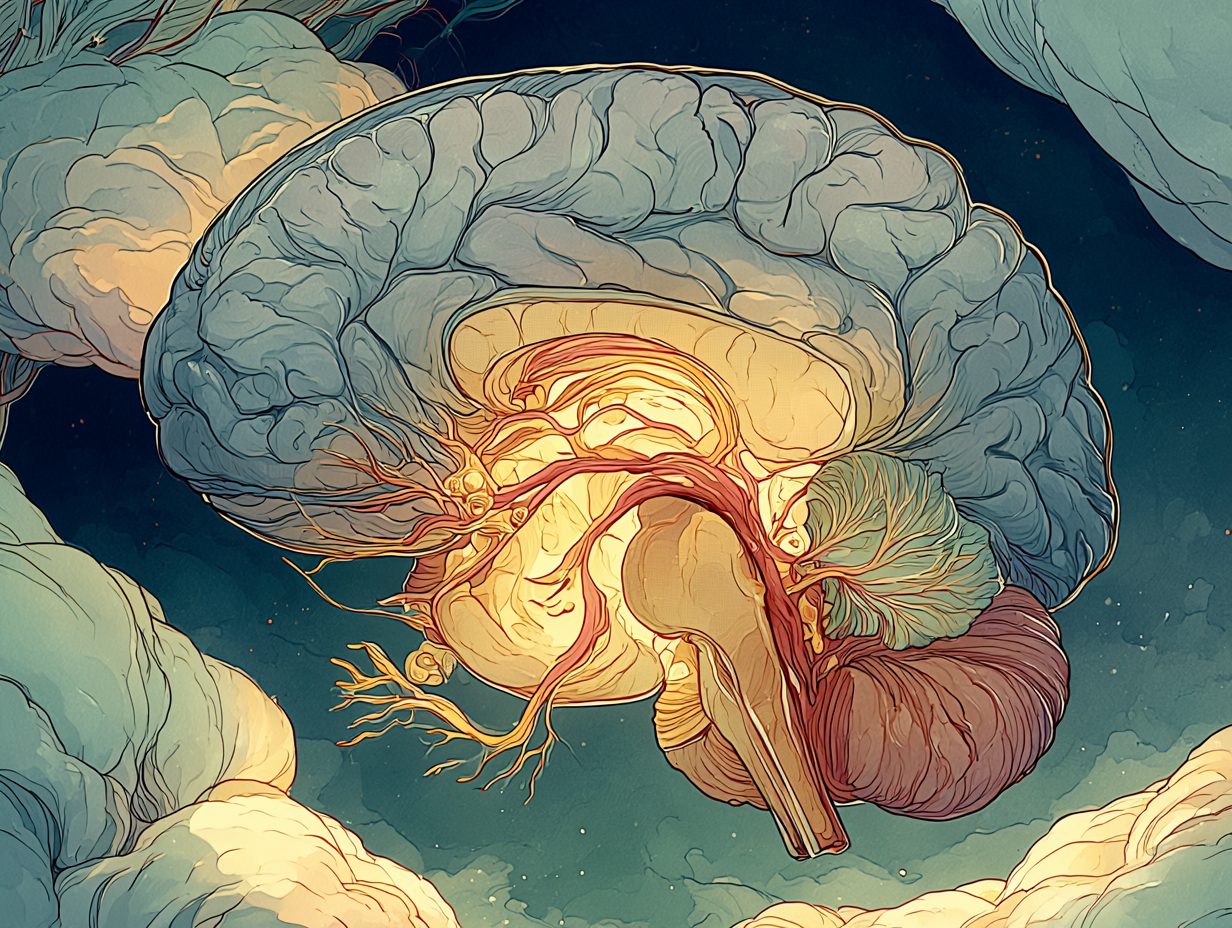
As I describe each system, you'll encounter neuroanatomical terms: specific brain structures and how they connect. The brain geography matters because it shows you that trauma reaches into your deepest systems and makes comprehensible why healing from trauma often requires working directly with these lower, older brain structures, not just your thinking cortex.
I've grounded the neuroanatomy in the three-story brain framework from Post 6. Your brainstem sits at the base, the most ancient part, controlling automatic functions like heartbeat and breathing. Your midbrain and limbic system form the middle level, where emotion originates and where your body's internal states are integrated with survival needs. Your cortex, at the top, is the newest part evolutionarily. It's where your conscious thought and decision-making happens.
Within the middle level sits the diencephalon, a collection of critical neural hubs that includes the hypothalamus, the thalamus, the pituitary gland, and others. When you encounter terms like "hypothalamus" or "thalamus," I'm referring to these specific structures.
You'll also encounter directional terms describing where within a structure a particular region sits. These come from Latin and can seem opaque at first, but the logic is consistent once you have it.
Medial means toward the center, toward the brain's midline. Lateral means toward the sides, away from that midline. The medial hypothalamus sits close to center. The lateral hypothalamus sits toward the outer edge of the same structure.
Dorsal means toward the upper surface of the brain. Ventral means toward the lower surface. These terms come from fish anatomy: dorsal is the back (think dorsal fin), ventral is the belly. In the human brain, because of how the brain bends forward on the brainstem, dorsal ends up meaning upper and ventral comes to mean lower.
Anterior means toward the front of the brain. Posterior means toward the back.
When you see two of these combined, as in dorsomedial or ventrolateral, they describe two dimensions at once: dorsomedial means upper and toward center, ventrolateral means lower and toward the sides.
One prefix worth knowing: peri- means "around." The periaqueductal gray, abbreviated PAG, appears in the neuroanatomy of nearly every system below. It is the gray matter surrounding the cerebral aqueduct, a narrow channel running through the center of the midbrain, and it functions as a relay point in almost all of Panksepp's circuits. When you see dPAG (dorsal PAG) or lateral PAG, that just tells you which portion of that structure is involved.
For each of the seven systems below, the full technical circuit description appears in a toggle block labeled "The [SYSTEM] Circuit's Neuroanatomy." You can expand it or skip it. The three-story brain summary in the main text is all you need to follow the argument.
SYSTEM 1: SEEKING
SEEKING is the forward-moving, exploratory energy of your nervous system: the impulse to investigate, to pursue, to move toward what interests you. Every mammal has it. It's the oldest of the seven in evolutionary terms, and the one that participates in virtually everything else you do. Before there is anger or bonding or fear, there must be SEEKING: the basic forward momentum, the dopamine-fueled impulse to engage with the world.
When SEEKING activates, you feel curiosity, interest, the pull toward engagement. You want to figure something out. You're drawn forward by the sense that something good might happen if you keep moving in this direction, and you do keep moving: absorbed in learning, fascinated by novel things, driven toward mastery. Behaviorally, this looks like exploration and investigation, persistence toward goals, the absorption in learning that marks mastery-seeking. The world, from inside SEEKING, feels full of possibilities worth pursuing.
The SEEKING Circuit's Neuroanatomy
The SEEKING system originates in two midbrain structures: the ventral tegmental area (VTA), which houses dopamine-producing neurons, and the periaqueductal gray (PAG), which provides the emotional tone of wanting. From there, dopaminergic fibers ascend through the medial forebrain bundle (MFB), a major pathway that passes through the lateral hypothalamus in the limbic system. The lateral hypothalamus integrates signals about your body's needs—hunger, thirst, and other internal drives—and relays them upward to forebrain targets. Your cortex sends goal-related information downward to the nucleus accumbens in the limbic forebrain, which translates the wanting impulse into action. The nucleus accumbens also receives inputs from your hippocampus (about context), your amygdala (about emotional significance), and your prefrontal cortex (about goals), all modulated by dopamine. This bidirectional conversation between your midbrain and forebrain—with your cortex sending plans downward—is where wanting becomes purposeful seeking. Dopamine provides the neurochemistry of anticipation and forward momentum, of the sense that something good might happen if you keep moving in this direction. The system retains full function even without a cortex, confirming that the raw seeking impulse originates in these subcortical structures, with your cortex elaborating it into conscious wanting and planned action.
In the three-story architecture from Post 6, SEEKING runs primarily through the second story with active participation from the third. The raw wanting impulse originates in the VTA and PAG of your midbrain: second story. It flows through the hypothalamus and nucleus accumbens, also second story, where your body's needs and social context get integrated with the drive to move. Your cortex, third story, then sends goal-related information downward into that limbic hub, shaping the raw impulse into purposeful, planned wanting. A hunger pang is second story. "I want to become a doctor" is the third story working with the same underlying energy.
It's important to distinguish SEEKING as a specific motivational system from sympathetic arousal as a more general physiological mechanism. SEEKING is driven by dopamine and creates forward-moving motivation. Sympathetic arousal, the activation that increases heart rate, sends blood to muscles, and mobilizes the body, is a broader physiological response that multiple systems utilize. SEEKING uses sympathetic arousal as its substrate, but so do FEAR and RAGE. What differs between these systems is not the arousal itself but how that arousal is organized and directed.
Organisms that don't investigate their world can't find food, can't locate mates, can't discover where the safe places are. SEEKING provides the energy and motivation for that exploration. It's the restlessness that keeps you moving, the curiosity that keeps you learning, the drive that prevents stagnation.
SEEKING spans a range. At its calibrated intensity, it produces necessary motivation: engaged learning, adaptive exploration, the drive to master your environment. When SEEKING becomes over-activated, it turns into obsession, addiction, and compulsive chasing, fueling endless reward-seeking loops where you are always pursuing something but never feel satisfied, where the wanting you experience becomes disconnected from your actual well-being. When SEEKING becomes under-activated or flattened, you experience anhedonia (the loss of pleasure): nothing interests you, your motivation drains away, apathy sets in, and you might even experience depression-like numbness where the world feels empty of possibilities. Trauma often dampens SEEKING, as does depression. One of the first signs of healing is the return of SEEKING: the restoration of curiosity, the reemergence of interest, the sense that there are things worth pursuing again.
Of the seven systems, SEEKING holds a particular position: it provides the rest of them their forward-moving energy. The other systems don't generate their own fuel; they mobilize and direct SEEKING's energy toward their specific goals. RAGE doesn't create its own aggression; it takes the arousal that SEEKING generates and directs it toward confrontation. FEAR doesn't create its own avoidance energy; it channels SEEKING's momentum toward escape. CARE doesn't create its own bonding drive; it directs SEEKING's energy toward the beloved's well-being. If SEEKING is the engine, the other systems function as steering. When SEEKING's output is dampened, all the other systems become less vital.
Because SEEKING is the energetic foundation, it influences and is influenced by all the other systems. RAGE activates SEEKING to remove an obstacle. FEAR activates SEEKING to find safety. CARE activates SEEKING to pursue the beloved's well-being. The system provides the energy; the other systems direct where that energy goes. This relationship between the energetic substrate and the directional systems is the foundation for understanding how your nervous system generates the full emotional complexity of your life.
SYSTEM 2: FEAR
FEAR is the threat-detection and avoidance system of your nervous system: what activates when you sense danger, what notices signals suggesting you are unsafe. It underlies vigilance and wariness, the impulse to escape or hide, the tightness of apprehension. Every mammal has it, an ancient genetic inheritance conserved because it kept ancestors alive. FEAR is what recognized the predator in the grass, the poisoned water, the dangerous stranger. You are alive because your ancestors had functional FEAR systems.
When FEAR activates, you experience wariness. Something feels wrong. You scan the environment, trying to locate the source. There is an urge to escape or hide, and your body begins mobilizing before you've consciously decided anything: freezing if the threat is immediate, moving away if escape is possible. Behaviorally, you see vigilance and quick startle responses, rapid shallow breathing, muscles that coil and lock. Your attention narrows onto the source of threat. You become hyperaware of exits and escape routes, your awareness of the room telescoping into threat-detection mode. In animals, FEAR looks like fleeing, hiding, or freezing; the frozen stillness of an animal caught in a predator's gaze.
The FEAR Circuit's Neuroanatomy
The FEAR system originates in the dorsal periaqueductal gray (dPAG), deep in your brainstem, which generates and executes the raw fear response. Your cortex sends threat information downward to your amygdala in the limbic system—information about what you perceive as dangerous based on your senses and past experience. Your amygdala in the limbic system acts as a relay station: it receives this information from above, integrates it with signals about your body's internal state from the medial hypothalamus (also in the limbic system), and communicates back and forth with the brainstem. This bidirectional conversation between your limbic system and brainstem is where the fear response is actually coordinated—your brainstem generates the physical fear response (freezing, fleeing, increased heart rate, stress hormones), while your limbic system learns which situations are threatening and adjusts the response accordingly. Meanwhile, your cortex becomes consciously aware of what's happening. The circuit runs on glutamate and corticotropin-releasing factor (CRF) as the main chemical messengers that activate fear, while GABA and neuropeptide Y act as natural brakes that slow it down.
In three-story terms, FEAR originates in the brainstem. The PAG, first story, generates the raw physical fear response: the freeze, the flight, the racing heart. Above it, your amygdala and hypothalamus in the limbic system, second story, learn which situations deserve that response and calibrate its intensity based on past experience. Your cortex, third story, is where fear becomes conscious, where you acquire whatever capacity you have to evaluate the threat in that moment. Your brainstem fires the fear response faster than the cortex can evaluate it. You are already flinching before the third story has decided whether flinching is warranted.
Organisms that can't recognize threat become prey. Those that can't escape danger don't survive to reproduce. FEAR is how you recognize invasion, how you detect that the environment has become unsafe, how you mobilize a response toward safety. It kept your ancestors alive when survival meant avoiding being eaten, avoiding poisoning, and avoiding the violence of others.
FEAR has a calibration problem in both directions. When it's under-activated, recklessness follows: an inability to recognize genuine danger, impulsivity that leads to preventable harm. When it's over-activated, it produces anxiety disorders, phobias, hypervigilance, the sense that everything is dangerous and the inability to distinguish real threats from imagined ones. Trauma often hyperactivates FEAR, the nervous system becoming convinced that threat is constant and imminent even when the actual danger has long passed. One of the goals of trauma healing is to return FEAR to its healthy range, where it can recognize real threats without overestimating them.
FEAR and RAGE share something important: both run on sympathetic arousal. Both increase your heart rate. Both send blood to your muscles. Both mobilize your body for action. It's the same engine: sympathetic activation borrowed from SEEKING. But where FEAR steers you toward escape, RAGE steers you toward confrontation. This is why you can experience both fear and anger about the same situation simultaneously. Your body is aroused. Your systems are activated. Both are real. Both are you. They're just steering the same arousal in different directions at the same time.
FEAR influences and is influenced by other systems. FEAR can constrain RAGE by introducing awareness of consequences: fear of legal trouble, fear of losing the relationship, fear of harm can all moderate rage and prevent it from becoming pure aggression. SEEKING motivated by FEAR drives you to seek safety, to seek escape routes, to seek resources for protection. CARE and FEAR work together to protect what you love: CARE makes you devoted to those you're bonded with, FEAR makes you protective of them from danger. But FEAR can also suppress CARE. When you are very frightened, the capacity for tenderness becomes less available. When FEAR dominates, survival takes priority over connection. Understanding when FEAR is active and when it's not is central to understanding how your entire emotional system coordinates or fails to coordinate.
SYSTEM 3: RAGE
RAGE is the boundary-protection and obstacle-removal system of your nervous system: what activates when something blocks your goal, when your boundary is violated, when your autonomy is threatened. It's the impulse to push back, to assert "No", to confront what stands against you. Every mammal has it, the activation typically emerging when gentler approaches have failed. People often misread RAGE as pathology, as something that should not exist. It's more accurately understood as an emotional immune system: capable of recognizing invasion and mobilizing defense.
When RAGE is active, you experience heat, anger, the drive to fight or assert. You feel the impulse to confront, to push against, to say no with force. Your sense of injustice, the sense that something is wrong and must be corrected, is heightened. Behaviorally, you see confrontation and assertion. Your muscles mobilize. Your voice rises. Your words come faster. You see threat displays in animals: the bared teeth, the bristling fur, the posturing that says "I will not back down." In humans, RAGE looks like raised voice, rapid speech, the physical stance of someone prepared to fight, and words that carry intensity and refusal.
The RAGE Circuit's Neuroanatomy
The RAGE system originates in the medial amygdala in your limbic forebrain, which acts as a sensory gateway for threats to your autonomy and boundaries. From there, the circuit flows through the bed nucleus of the stria terminalis (BNST), also in the limbic forebrain, which modulates the circuit's tone. The signal then descends to the medial hypothalamus in the diencephalon, the principal integrative hub of the RAGE circuit, which receives inputs about your body's state and threat level. The medial hypothalamus sends descending signals to the dorsal periaqueductal gray in your brainstem, the final executor of rage; the structure that commands the full confrontational response: raised voice, rapid speech, muscular mobilization, and sympathetic activation. Unlike FEAR, which originates in the brainstem and flows upward, RAGE originates in the forebrain and flows downward toward execution. Your cortex sends top-down inhibitory signals that can restrain this circuit, but the core RAGE response originates in these subcortical structures and retains full function even without cortical input. Like FEAR, RAGE mobilizes the same sympathetic arousal and forward-moving energy, but steers it toward confrontation rather than escape. The circuit relies on substance P from the amygdala, and glutamate at the hypothalamic-PAG junction to drive rage, while enkephalins and GABA provide inhibitory brakes.
RAGE threads through the brain's three stories in the opposite direction from FEAR. FEAR runs bottom-up. RAGE runs top-down. It originates in the limbic forebrain, second story, and flows downward toward execution in the brainstem, first story. Your amygdala and its downstream structures initiate the circuit. The PAG in your brainstem executes the physical confrontational response: the raised voice, the muscular mobilization, the forward lean. Your cortex, third story, sends inhibitory signals downward trying to restrain this circuit. When that top-down braking works, you experience the anger and can choose your response. At sufficient intensity, though, the cortex loses the argument. The circuit executes directly.
Individual survival requires the capacity to push back against violation. An organism that can't remove obstacles to its goals becomes trapped. RAGE is what enables assertion. It's the system that says "This will not stand. I will protect what is mine: my body, my boundaries, my values." Without RAGE, you become permeable to others' incursions, unable to maintain yourself in the face of outside pressure.
RAGE also has a spectrum. At its healthy calibration, RAGE functions as that emotional immune system, recognizing invasion and mobilizing protection. A parent setting a firm boundary with a child provides an example: RAGE balanced with CARE. "I care about you. AND this behavior will not continue in this house." The care is genuine and the boundary is firmly set. RAGE serves its protection function while CARE provides a relational container that prevents harm. When RAGE becomes over-activated it can turn into aggression and violence, into cruelty and predatory harm, into the destruction that comes from anger executing without wisdom. Personal boundary collapse follows when RAGE is suppressed or becomes under-active: you cannot say no or protect yourself from incursions. You absorb and accommodate the emotions and needs of others, taking responsibility for the feelings and actions of others and end up self-neglecting. Abusers love it when they encounter someone who has a difficult time saying no, as this under-active RAGE state constitutes a major vulnerability they can exploit.
The CARE-RAGE relationship is particularly important. These two systems work in productive opposition. When CARE dominates without RAGE, self-neglect follows, where you lose yourself in taking care of the other's needs, and fail to maintain your own boundaries. When RAGE dominates without CARE, cruelty emerges: you feel entitled to harm or exploit the other person as punishment for their transgressions. When both systems are available at the same time, what you might experience is boundaried love. "I care about you deeply AND my boundaries are non-negotiable." Most intimate relationship dysfunction involves either too much RAGE (becoming aggressive) or too much CARE (becoming exploitable). The goal is not to eliminate one or amplify the other, but to restore both systems' capacity for integrated cooperation.
FEAR can constrain RAGE through awareness of consequences: fear of legal trouble, losing the relationship, harm to others; all of these can moderate RAGE and prevent it from becoming aggression. This is why the angry man I described in the third opening story could be remorseful and penitent, desiring to change his aggressive ways while in my therapy office, but found his determination to be better dropped away while driving. He was able to describe his healthy fear of legal consequences while in my office, but when his RAGE reached high activation while driving, that same FEAR became inaccessible.
RAGE also influences and is influenced by other systems. RAGE can activate when your SEEKING is blocked: when you're pursuing a goal and something blocks you, RAGE mobilizes to remove the obstacle. But RAGE also suppresses other systems when it reaches high activation. When RAGE is intense, the systems that would counsel caution or compassion become less available. Your capacity for empathy diminishes. Your ability to consider long-term consequences disappears, replaced by only your desire to win right now regardless of consequence. What remains is the heat and the impulse to act on it. This diminishing of constraints under high activation is the mechanism behind the oscillations from the third opening story: high RAGE suppresses cortical reasoning and empathy that would counsel restraint. Understanding this is the beginning of working with RAGE rather than being controlled by it.
SYSTEM 4: CARE
CARE is the nurturance and bonding system of your nervous system: what drives you to respond to vulnerability, to protect what you love, to create secure connection. Every mammal has it. It's the system that keeps offspring alive, that creates the bonds allowing development and learning, that makes secure attachment possible. Species survival depends on CARE. So does everything that grows.
When CARE is active, you experience tenderness, protective impulses, the desire to help. You are moved by another's vulnerability. You feel the warmth of connection, the impulse to comfort and be near. You find yourself attuned to others' emotional states, responsive to their needs. Behaviorally, you see caretaking and grooming. You notice comfort-seeking and comfort-giving. You see the physical closeness of bonding, the attunement between caregiver and child, the responsiveness that says "I see you and I care about what happens to you."
The CARE Circuit's Neuroanatomy
The CARE system originates in the medial preoptic area (MPOA) in your hypothalamus, which is a limbic system structure in the diencephalon that integrates hormonal signals during pregnancy with sensory cues from your infant. From there, the circuit flows along two main pathways. One pathway ascends to the ventral tegmental area in your midbrain, which releases dopamine to the nucleus accumbens in your limbic forebrain—this creates the rewarding, pleasurable quality of caregiving and drives maternal motivation. The other pathway flows through the bed nucleus of the stria terminalis in your limbic forebrain to coordinate neuroendocrine responses and motor patterns through the paraventricular nucleus—also in the limbic system—and the periaqueductal gray in your brainstem. Your MPOA also actively suppresses the aversion circuits in your medial amygdala in the limbic forebrain that would otherwise make infant odors and cries aversive, allowing approach and caregiving instead. Your anterior cingulate cortex in the cortex evaluates the affective significance of infant-related stimuli. This dual architecture ensures that caregiving feels rewarding, that fear and avoidance are suppressed in favor of approach, and that you experience the warmth and pleasure of bonding. The circuit relies on oxytocin released from the hypothalamus, prolactin during pregnancy and nursing, estrogen and progesterone priming the MPOA during late pregnancy, endogenous opioids that make bonding pleasurable, and dopamine that drives the motivation to seek out and care for your infant.
Mapped onto the three-story brain, CARE is centered in the hypothalamus, a second-story structure that coordinates the circuit in two directions simultaneously. From there it branches: one pathway ascends through the limbic reward system, still second story, creating the warm, pleasurable quality of caregiving. Downward goes a second pathway into the brainstem, first story, executing the physical patterns of nurturing: the approach, the comfort, the responsiveness. Your anterior cingulate cortex, third story, evaluates the emotional significance of the caregiving moment. Your hypothalamus also actively suppresses threat-detection circuitry in the amygdala during caregiving, so vulnerability can be met with approach rather than avoidance. Second-story bonding chemistry overriding second-story threat detection.
Offspring don't survive without care. A human infant abandoned would die. The survival of the species depends entirely on CARE: on adults showing up, providing protection, responding to vulnerability. CARE creates the secure bonds that allow development to unfold, that teach young mammals how to be in relationship, that provide the foundation for all learning and growth.
CARE, like all seven systems, has a spectrum. At healthy activation, CARE produces protective caregiving that maintains boundaries. It creates secure bonding where self-care and other-care exist in dynamic equilibrium. You care for others deeply AND you care for yourself equally. When CARE becomes over-activated without the restraint of other systems, fusion and self-neglect follow. You lose yourself in the other's needs and fail to maintain your own boundaries. You absorb the emotions and needs of others and make those others' feelings your responsibility. Overactive CARE constitutes a major vulnerability to exploitation, in that you potentially become available to whoever figures out how to activate your CARE system most effectively, regardless of whether they deserve that care. Coldness emerges when CARE becomes under-activated or absent. You cannot bond, you cannot respond to vulnerability in others or in yourself, and you lack the relational constraint that makes you safe to be around. This is one marker of predatory capacity.
The CARE-RAGE dynamic appears from both directions, and I described it from the RAGE side in the previous section. To see it from the CARE side: when CARE dominates without RAGE, you lose yourself in the other's needs. When RAGE dominates without CARE, your capacity for cruelty emerges. When both are operating together, you get boundaried love: "I care about you deeply AND my boundaries are non-negotiable. I'm invested in your wellbeing AND I will not sacrifice my own." Most intimate relationship dysfunction involves either too much RAGE or too much CARE. The goal is to restore both systems' capacity to operate together.
CARE influences and is influenced by other systems. CARE can over-activate SEEKING, such that your pursuit of managing your beloved's well-being becomes a consuming drive. PLAY amplifies CARE, deepening bonds through joy and laughter. But CARE can also be suppressed by high activation of other systems. When RAGE is dominant, your compassion becomes less available. When FEAR is high, your capacity for tenderness diminishes. Understanding when CARE is accessible and when it's suppressed is central to understanding your capacity for authentic intimacy.
SYSTEM 5: PANIC/GRIEF
PANIC/GRIEF is the separation-distress system of your nervous system: what activates when connection is lost, when abandonment threatens, when you are separated from those you are bonded with. Every mammal has it. It creates the ache of missing someone, the pain of loss, the desperate searching when something precious is gone. This system kept your ancestors bonded. Separation from the group meant death, and the pain of separation motivated reunion.
When PANIC/GRIEF is active, you experience the ache of missing someone, yearning, the impulse to cry out or search. There is despair, the sense that something essential has been taken. You find yourself calling out, looking for the lost person or connection. Behaviorally, you see crying, calling out, searching, clinging. You see the protest against abandonment. In animals, PANIC/GRIEF looks like the distress call of a separated young mammal, the desperate searching of an animal separated from its group.
The PANIC/GRIEF Circuit's Neuroanatomy
The PANIC/GRIEF system originates in the dorsal periaqueductal gray (PAG) in your brainstem, which generates the raw unconditioned distress response; the engine of separation crying and autonomic arousal. Ascending signals travel through the dorsomedial thalamus in your midbrain, relaying affective information upward. The signal engages the bed nucleus of the stria terminalis (BNST) and ventral septal area in your limbic forebrain, which integrate the distress signal with contextual and social information and modulate stress hormones through connections to the paraventricular nucleus in your hypothalamus; a structure in the diencephalon. The preoptic area of the hypothalamus, also in the diencephalon, serves as a critical node where attachment neurochemistry (opioids, oxytocin, prolactin) interfaces with and inhibits the distress signal. Finally, the anterior cingulate cortex (ACC) in your cortex receives the fully elaborated signal and generates the conscious experience of social or psychological pain. The ACC also sends descending feedback to the PAG that can suppress or sustain distress output depending on context and learning.
Following the three stories from the bottom up, PANIC/GRIEF begins in the brainstem. The PAG, first story, generates the raw distress of separation, the cry, the autonomic arousal, before any higher level of the brain has processed what happened. That signal ascends into the second story, where the thalamus relays it upward and the limbic structures integrate the distress with attachment chemistry and contextual information: is this separation temporary or permanent? Is care available? The fully processed signal reaches the anterior cingulate cortex, third story, where it becomes conscious psychological pain. Your cortex also sends descending feedback to the brainstem that can either suppress or sustain the distress depending on what the nervous system has learned about whether help is coming. That bidirectional conversation between the first and third story is part of why therapy can reach grief.
It's useful to think of PANIC/GRIEF as having three states of activation. There is a satiation state where the circuit is quiet, there is a panic state where the circuit is generating active distress, and then there is a grief state where the circuit predicts that no care is coming and the distress turns towards hopeless resignation. The circuit's state of activation depends on opioidergic tone:
In satiation, when you are securely bonded and your attachment needs are met, endogenous opioids released through secure attachment keep the PAG tonically inhibited and your SEEKING system active. You feel safe, secure, and content.
In the panic state, opioid tone drops below threshold when separation or loss occurs. The PAG fires intensely, the dorsomedial thalamus amplifies the ascending signal, and your SEEKING system co-activates in desperate searching for care. You experience acute psychic pain and frantic distress.
In the despair state, sustained PANIC overarousal exhausts the system. The PAG shifts to a passive conservation and withdrawal mode, your SEEKING system becomes suppressed, and your ACC enters a ruminative, inward-focused state consistent with depression. You experience hopelessness and amotivation.
This three-state model explains why restoration of opioidergic tone through secure attachment or pharmaceutical approaches like low-dose buprenorphine can shift a person from despair back toward satiation, and why reactivating the SEEKING system is essential to recovery.
The evolutionary logic here is stark: in the ancestral environment, separation from the group meant death. The infant separated from its mother would die. The individual separated from the tribe would die. Activation of the PANIC/GRIEF system kept individuals bonded even when separated, because the pain of separation motivated their reunion. You can only grieve what you cared about.
What PANIC/GRIEF teaches is something no other system can: what loss actually means. In its healthy range, PANIC/GRIEF produces appropriate mourning, the capacity to grieve and integrate loss. It creates separation anxiety that motivates reunion when separated from loved ones. It teaches you what connection means and therefore what is worth protecting. When PANIC/GRIEF becomes over-activated, chronic grief follows: abandonment anxiety, desperate clinging, the inability to move forward after loss. When PANIC/GRIEF becomes under-activated or absent, you cannot mourn. Loss becomes flat and meaningless. There is indifference to separation. The absence of longing signals a break in the capacity for attachment itself.
Grief is not dysfunctional! It is the nervous system's way of honoring connection and letting you adjust to the pain of loss in increments. The pain of grief proves that something mattered. Healthy grief involves oscillation: accessing the pain, then retreating to recover, then accessing it again. Over months and years, the nervous system metabolizes the loss. There is no pathology to such oscillation; it is the system working correctly. Healing from loss requires mourning, not just moving on. It requires feeling what has been taken and integrating that reality into a new understanding of who you are.
PANIC/GRIEF influences and is influenced by other systems. CARE and PANIC/GRIEF are intimately connected, grief being the painful flip side of bonding. PANIC/GRIEF can activate RAGE, where grief becomes anger at betrayal, anger at loss itself, or anger at injustice. PANIC/GRIEF can co-activate with SEEKING, motivating a search for the lost person, the lost version of the relationship, the lost self. Understanding the role of PANIC/GRIEF in healing is essential because it means that healing from trauma requires not just understanding what happened but also mourning the losses that occurred.
SYSTEM 6: PLAY
PLAY is the joy and social-bonding system of your nervous system: what creates laughter and lightness, what bonds individuals through fun and connection rather than intensity. Play seems frivolous until you examine its function. In fact, play is how mammals teach each other cooperation, create social cohesion, and generate the enjoyment that makes bonding worth seeking. That enjoyment, in turn, heightened the chances of survival in the ancestral environment.
When PLAY is active, you experience laughter, lightness, the joy of connection. You feel playful, silly, capable of being fun and engaging. You experience the pleasure of being with others in a non-serious way. Behaviorally, you see laughter and roughhousing, joyful movement and playful silliness, the easy connection that comes through fun rather than intensity. In animals, PLAY looks like the playfulness of young mammals wrestling together, the running and chasing that bonds and teaches without threat.
The PLAY Circuit's Neuroanatomy
The PLAY system's core executive circuit centers on the parafascicular nucleus (PFA) in your thalamus (a critical diencephalic hub) which projects to the dorsal striatum and nucleus accumbens in your forebrain and receives reciprocal input from your prefrontal cortex. The parafascicular nucleus is the single most important node: damage here significantly reduces play, while intact animals show strong activation of the striatum during playful activity. Somatosensory input from playful bodily contact ascends via the ventrolateral brainstem to the thalamic intralaminar nuclei, where it's integrated and sent to the striatum for action selection and motor sequencing of play behaviors.
The lateral periaqueductal gray (PAG) in your brainstem provides the affective-vocal component of play—the joy and laughter—and is activated specifically during play and tickling. Your medial preoptic area in the hypothalamus—a diencephalic structure—coordinates reward and affective regulation during play through projections to both the ventral tegmental area in your midbrain and the lateral PAG in your brainstem. The system relies on dopamine from your midbrain for motivational drive, endogenous opioids for the pleasurable quality of play, endocannabinoids for sensory processing, and acetylcholine for modulation at multiple nodes. Crucially, your cortex modulates play's complexity and social flexibility but is not required for play's generation. Neonatally decorticated animals still play, confirming that PLAY is a subcortical and ancient evolutionary system.
Translated into three-story terms, PLAY lives primarily in the second story, with its affective output generated in the first. The thalamus and striatum, second story, coordinate the social and motivational components of play. But the physical joy itself, the laughter and exuberant movement, comes from the lateral PAG in your brainstem: first story. The cortex contributes social flexibility and complexity but isn't required for play to happen at all. When play disappears in a person, the system that went quiet is primarily subcortical. Restoring it requires reaching below the third story.
Play bonds individuals, teaches cooperation, and creates social cohesion. Those functions contributed directly to survival in the ancestral environment. PLAY is the system that makes being with others genuinely enjoyable rather than merely obligatory. Without PLAY, relationships become grim, sustained by need rather than desire.
PLAY also has a spectrum. In its healthy range, PLAY produces capacity for joy, bonding through play, the ability to access lightness even in difficulty. Relational connection that doesn't require intensity or seriousness. When PLAY becomes over-activated, what we might call manic play emerges: inappropriate laughter, dissociative joking, the use of play to avoid serious material. When PLAY becomes under-activated or absent, the capacity for joy disappears. Life becomes grim and serious. Relational distance increases. Trauma often forecloses PLAY, shutting this system down, which is one reason trauma creates such a pervasive sense of heaviness and hopelessness.
Playfulness is one of the more reliable signals of nervous system health. When this system goes quiet, something serious has happened. The restoration of playfulness, the capacity to be genuinely silly and light, is one of the clearer markers of healing from trauma. The capacity to laugh without guilt, to be silly without it meaning you're not taking your healing seriously, to access joy while honoring pain: these forms of integration signal that your nervous system is recovering its capacity to experience a fuller and more satisfying life.
PLAY influences and is influenced by other systems. PLAY deeply connects to CARE: play bonds people and creates secure attachment through joy and fun. PLAY is in tension with PANIC/GRIEF: it's hard to play when grieving, but laughter can be a healing tool in the process of mourning. PLAY activates SEEKING: seeking playful connection with others, seeking joy and engagement. PLAY works with LUST: sexual play, flirtation, erotic joy all combine PLAY with sexual system activation.
SYSTEM 7: LUST
LUST is the sexuality and reproduction system of your nervous system. LUST's territory includes sexual motivation, sexual desire and sexual bonding. The system is individual in its activation (each person's particular version of desire is their own) and yet serves species survival through reproduction. Every mammal has it, though its expression varies enormously across species, individuals, and cultures.
When LUST is active, you experience sexual attraction and desire. You feel arousal and the pull toward physical connection, the pleasure of sexual engagement. Behaviorally, you see sexual arousal and approach toward attractive others. You see sexual bonding behaviors, the physical intimacy that deepens connection through sex.
The LUST Circuit's Neuroanatomy
The LUST system originates in your corticomedial amygdala in your limbic forebrain, which processes chemosensory and sensory information about potential mates through your olfactory system. From there, the circuit flows through the bed nucleus of the stria terminalis (BNST) in your limbic forebrain, which relays signals to the medial preoptic area (MPOA) and ventromedial hypothalamus (VMH), both structures in your hypothalamus, a diencephalic hub. In males, the MPOA integrates hormonal status, sensory information, and motivational signals to coordinate sexual behavior. In females, the VMH plays a more dominant role in executing consummatory sexual behavior. From there, the circuit descends to the periaqueductal gray in your brainstem, which coordinates the motor, autonomic, and hormonal adjustments necessary for sexual expression. Your LUST system also engages the mesolimbic reward pathway (comprised of your ventral tegmental area and nucleus accumbens) linking sexual motivation to your SEEKING system. The circuit depends on testosterone and estrogen driving sexual motivation, oxytocin facilitating sexual behavior, vasopressin contributing to pair-bonding, and various neuropeptides modulating desire and performance at multiple nodes. This entire system is subcortical and sexually dimorphic, reflecting its ancient evolutionary roots and its functional independence from your conscious cortex.
In the three-story framework, LUST runs almost entirely through the second story with execution in the first. The amygdala, BNST, and hypothalamic nuclei, all second story, process sensory information, integrate hormonal signals, and generate sexual motivation. The PAG in your brainstem, first story, coordinates the physical expression of sexual behavior. Notice what's largely absent from this architecture: the cortex. Sexual desire can activate and persist even when the third story, the rational and consequence-aware cortex, would prefer it didn't.
Of the seven, LUST has the most direct evolutionary logic: reproduction. The species continues because individuals seek sexual connection. Every mammal has this drive, though human sexuality is elaborated far beyond simple reproductive behavior by the cortex, culture, and its intersection with CARE, PLAY, and relational bonding.
LUST has a spectrum as well. In its healthy range, LUST produces sexual desire that connects people and creates embodied intimacy. When LUST becomes over-activated, obsessive sexuality emerges: compulsive seeking of sexual stimulation, sexual coercion, sexuality disconnected from relational care or consent. When LUST becomes under-activated or absent, sexual dysfunction follows: inhibited desire, the inability to bond sexually, relational distance.
Sexual trauma fragments LUST from relational connection in a way that no other system experiences quite as distinctly, separating desire from care and body from consent. The healing of LUST tends to come later in the sequence than work on the survival systems. But when it does return, when desire reconnects with care and consent and relational belonging, it marks something about the person's recovery that feels qualitatively complete.
LUST influences and is influenced by other systems. LUST can work with CARE, deepening intimate bonds through sexual connection and erotic pleasure. Or it can operate independently, driven sexuality without relational context. Healing includes the reconnection of sexuality with care, desire with consent, pleasure with relational integrity.
THE EVOLUTIONARY HEURISTIC: INDIVIDUAL VS. GROUP SURVIVAL
Now that you've encountered all seven systems individually, you might notice that they seem to cluster into coherent groups. I think this clustering reflects their evolutionary functions; the survival problems each system was shaped up to solve. Here's how I organize them.
The first group addresses individual survival. FEAR detects threat and mobilizes avoidance. RAGE protects boundaries and removes obstacles. SEEKING drives exploration and resource acquisition. These three systems prioritize the survival and autonomy of the individual organism. They keep you alive and capable of thriving on your own.
The second group addresses group and species survival. CARE creates the bonds that allow offspring to survive and develop. PANIC/GRIEF maintains bonding even when separated, creating the felt experience of what connection means. PLAY bonds individuals through joy and cooperation, creating social cohesion. These three systems prioritize connection, attachment, and the continuation of the species.
In the middle sits LUST, the individual-level reproductive motivation that carries species-level consequence. It serves the individual drive toward sex and reproduction, but also the species imperative of continuation.
What I find elegant about this architecture is the productive tension it creates. Group circuits create vulnerability. You cannot bond socially without risk of loss. You cannot attach without exposing yourself to the risk of abandonment. But individual-level motivational circuits provide the necessary protection against that vulnerability. RAGE protects against CARE's tendency toward fusion. FEAR moderates RAGE's potential for aggression. SEEKING drives you toward goals even when connection is difficult. Conversely, individual circuits operating alone could isolate you completely. SEEKING could drive endless accumulation without care for others. RAGE could become pure aggression. But species-level social bonding circuits maintain group connections. CARE tempers RAGE. PLAY keeps you engaged with others. PANIC/GRIEF makes you feel what connection means. Together, they create something neither could alone: a nervous system capable of both protecting itself and bonding deeply, of both the pursuit of purely individual motivations and the imperative of secure attachment.
Please treat these groupings as more a helpful heuristic and less a structural truth. The conservation of these motivational systems across long periods of time suggests all seven of them make vital and necessary contributions towards ensuring survival. Individual survival enables reproduction, while group bonding ensures offspring survive. The division I've offered assists in understanding how the seven systems organize around survival logic. But in practice, all seven systems work together in constant relationship.
THE CONSISTENT PATTERN ASSOCIATED WITH HIGH ACTIVATION
The evolutionary vs. group survival heuristic helps you to understand each system's individual role in promoting survival and how they relate to each other evolutionarily, but it does not yet explain the oscillations you saw in the three opening stories: the woman caught between bonding and anger, the man between excitement and caution, the man between rage and restraint.
To understand that oscillation, we need to understand something still more complex: what happens to these systems when they are interacting with one another under pressure and one of them reaches high activation. When this becomes the case, what can occur next is that the rest of the systems take a step back, and the organism temporarily comes, more or less, under the dominant control of just that one highly activated system.
When the abused woman's CARE system is highly activated by her husband's victimized narrative, her capacity for RAGE diminishes. The anger that would otherwise protect her boundaries becomes less accessible. Her cortical reasoning, that part of her that could logically evaluate his claims against evidence, becomes quieter. She experiences his emotional reality as truth because in that moment her nervous system becomes organized around maintaining her bond with him at all costs.
When the man with bipolar disorder experiences a hypomanic episode and his SEEKING system goes into overdrive, intensifying his excitement and forward momentum, his FEAR of consequences becomes less available. Some part of him continues to know he doesn't have the money to spend as he does, but that knowledge isn't accessible with the same force as it was when he was at baseline. What feels real and true in the moment is the sense of possibility, the rightness and pleasure of acquiring what he needs, the forward pull, the anticipation, the SEEKING.
When the man with anger issues experiences high RAGE activation while driving, during which his sense of injustice intensifies, his capacity for empathy and reasoning diminishes. The insight he demonstrates in therapy about restraint and consequences continues to exist in his brain. However, when RAGE is running hot, that knowledge becomes less available to counter his impulse to "teach someone a lesson".
Though the specifics change across scenarios, the pattern is consistent: when any emotional system reaches high activation, other systems become less available. Cortical reasoning and logic dims. Empathy diminishes. Long-term perspective contracts. The systems that would counsel caution or compassion or consequence-awareness grow quiet.
From an evolutionary perspective, this is a benefit rather than a problem. The reason is simple: speed.
When something is genuinely urgent and threatening such that survival requires your immediate and full coordination around addressing that threat, any interference from competing systems would only slow down your response. When it is life or death (or feels that way) the one system most capable of addressing the threat becomes dominant and the others step back. This re-allocation of resources under pressure kept your ancestors alive. A gazelle being chased by a lion isn't helped by thinking about mating or socializing or eating. It needs to run. The systems that would distract from survival quiet down.
But there is a cost: knowledge that feels absolutely solid in a calm state becomes inaccessible in a state of high activation. You know what you should do. You commit to it sincerely and mean it completely. And then, when you become highly activated again, that knowledge is simply not available to help you when you need it.
This is the mechanism driving the ambivalent motivational oscillations described in the three opening stories.
When it seems your survival is at stake, your nervous system reprioritizes and restricts how its various components influence each other to produce what it calculates as the best survival solution in that moment. The problem is that this "best solution" is arrived at without consideration of long-term consequences, and can easily result in you taking actions that made sense only in the moment and that end up hurting you later.
Problematic as it can become, this prioritization is a product of your nervous system being architected for survival. Seeing it for what it is rather than viewing it as a lack of willpower or weakness changes how you can relate to your own ambivalent oscillations. Instead of blaming yourself for knowing better and doing it anyway, you can begin to understand what's happening in your nervous system and learn to work with its architecture rather than against it.
FROM UNDERSTANDING MOTIVATIONAL SYSTEMS TO UNDERSTANDING YOURSELF
At this point you've done the work to appreciate how your motivation systems are organized. You've further seen how interactions between these motivational systems can give rise to the ambivalent oscillations that trapped the people introduced in the three stories. You would be forgiven if you had come to assume that all such oscillation is bad for you. However, that's not the case. Though oscillation shows up everywhere in human life, not all of it is dysfunctional. In some cases, the presence of motivational oscillation is better thought of as a gift from your nervous system. Let me show you what I mean.
WHEN OSCILLATION SERVES HEALING
I knew another man who had come to work with me together with his wife for couples therapy. Several sessions into that work, the wife died. The cause of her death was not known immediately, but the permanence of her death was indisputable. The man was inconsolable.
Recognizing the crisis, we quickly reconfigured the therapy to serve his need for someone to help him process the intense grief he was experiencing. His grief was ubiquitous, triggered and re-triggered repeatedly by everything he interacted with. He would be in the kitchen and see her favorite mug, the reality of her loss again crashing in on him: she will never drink from this mug again. She will never come through that door. She is gone.
From the motivational systems perspective this man was captured entirely by his hyperactive experience of PANIC/GRIEF. He felt the permanence of her absence. He cried and cried and then cried again. He sat in complete and painful contact with the loss of her, unable to function.
But there is something in the nervous system that recognizes that this level of pain is too much to sustain. No one can remain in contact with such pain in every waking moment. The nervous system would collapse.
So after a few hours of intense crying, something would shift inside him. A friend would call. He would make dinner. He would work on something that required his full attention and find he could manage to do this for a short while. The intensity of his grief experience receded, moving him temporarily away from the edge. It was as though his nervous system was saying: "You've felt enough pain for now. I'll give you a break."
And of course, a while later on he would again hear the song she loved, or he would dream of her, or he would stare at the video game console they both used to like to play. The pain of the loss would return in full force, him feeling again completely immersed in grief.
This sort of oscillation, between experiencing the pain of loss and temporarily retreating from it, is the normal course and pattern of the grief process. Think of it as a form of emotional titration. Through such alternation, the nervous system works to preserve both the need to process the reality of loss, and the man's capacity to catch his breath even just a little bit so that he could continue to function.
When such oscillation fails to be present, grief becomes stuck, either moving into chronic depression (endless contact with pain) or denial (no contact with the loss and no integration). With the oscillation available, the nervous system can hold and digest the enormity of the loss bit by bit such that slowly over time recovery occurs.
Over the course of a year and a half, I watched this man slowly digest the loss of his wife such that eventually she became a part of his history rather than a part of his day to day lived experience. Through the grief process he was able to learn to accept the loss of his wife, and how to hold her in a different way than before such that he could go on with his life.
Dysfunctional oscillation perpetuates problems. Healing oscillation metabolizes them. The difference between the two lies not in the mechanism but in what it accomplishes or fails to accomplish. I'll return to this distinction extensively when we discuss mourning and healing, because these same stages of oscillation are how the nervous system heals from trauma itself.
RETURNING TO OUR THREE STORIES: HOW OSCILLATION WORKS
Now that you understand Panksepp's seven systems and how they operate, let's revisit the three people from the opening and understand what was happening in their nervous systems to produce their cyclical, stuck behavior. The mechanism driving each oscillation is essentially inhibition: when one emotional system reaches high activation, the others and the cortex become less available. That suppression of the systems that would normally provide restraint, wisdom, or balance is what drives the oscillations I described.
The Abused Woman: CARE Dominant — RAGE and Cortical Restraint Suppressed
During their late-night conflicts, the abused woman's CARE system activates at high intensity, suppressing her RAGE and her cortex's capacity to evaluate her husband's claims. And as she shifts into CARE, he senses the shift and his own RAGE steps back. He moves into CARE as well, offering her more caring behavior. In this state, she takes on his emotional reality as her own and experiences his interpretation of events as truth, validated now by his softened behavior. Hours or days later, her RAGE breaks through again and the pattern of manipulation becomes suddenly visible, but in this new state her CARE is suppressed and her compassion becomes harder to access, for him or herself.
The Bipolar II Man: SEEKING Dominant — FEAR and Cortical Restraint Suppressed
When his mood cycles upward, the bipolar man's SEEKING system activates at high intensity, suppressing his FEAR and his cortex's capacity for thinking about long-term consequences. In this state, each acquisition appears genuinely good. Weeks or months later, his mood normalizes, the credit card statements arrive and his debt becomes suddenly visible, causing him to feel ashamed and depressed with regard to his loss of judgment and fearful it will happen again.
The Angry Man: RAGE Dominant — FEAR and Cortical Restraint Suppressed
When a driver cuts him off, the angry man's RAGE system activates at high intensity, suppressing his FEAR and his cortex's capacity for proportional reasoning and empathy. In this state, the other driver's actions feel like a personal affront, the confrontation feels justified, and the correction feels necessary, all validated by the heat of his RAGE. Hours or days later, as his RAGE cools, the consequences of his actions become visible and he recognizes what he's done.
What All Three Have in Common
All three share the same mechanism: when one emotional system reaches high activation, other systems become less available. Not permanently suppressed, but less accessible in that moment.
Take the woman: her CARE system dominates and RAGE goes quiet, along with her cortex's capacity to evaluate her husband's claims. For the bipolar man, SEEKING takes over: FEAR steps back. For the angry driver, RAGE floods the system and both FEAR and empathy recede.
All three individuals know their patterns and could tell you what they should do to address their situations, at least some of the time. Their desire for change is genuine enough, it's just not stable. In the moment when their oscillating systems re-activate, the knowledge they need to prevent repetition is no longer accessible in the way it was earlier.
The solution to the problem is simple but not in the slightest easy to implement. There is no need to eliminate anything. What is needed is to help it become the case that all of the systems, including the cortex, can remain in integrating conversation throughout the crisis. If the emotional systems are like musicians in an orchestra, then what is needed is for them to learn how to play together, under the direction of the cortical conductor. The systems that provide restraint, wisdom, and integration need to remain available even when another system activates at high intensity.
I'll help you to appreciate what's involved in causing this integrated state to come into being in later posts discussing trauma, dissociation, and healing. For now, understand this:
Your multiplicity is not your enemy. Your systems are not in conflict because they're broken. They're in conflict because they haven't learned to coordinate.
And they can learn to coordinate! That's what the rest of this series is about.
WHERE ARE YOU ON THE SPECTRUM?
Motivational oscillations are normal. Because the seven Pankseppian affective motivational systems are baked into everyone's brains from birth, the type of oscillations I have described in this post are commonly observed in people's experience. You've probably been thinking about your own experience of motivational oscillation or ambivalence as you've been reading, and wondering whether your own oscillations fall within or outside the normal range of functioning.
Motivational oscillations arise from how the different motivational systems dynamically interact with one another and with the cortex. It happens to everyone to some degree, though the phenomena involves a spectrum of intensity that impacts what people perceive and how they behave. To help you better appreciate where your own experience falls on this spectrum, I'll now describe what people's experiences are like at different points across the spectrum's range.
At the lowest intensity end of the oscillation spectrum, people do not report much experience of motivational ambivalence, instead for the most part experiencing strong narrative continuity. When their different systems activate, it feels like "that's me being angry" or "that's me being tender". They may notice that they are having a particularly toned emotional experience, but they do not experience this as at all disruptive to their sense of self, which remains recognizable to them across all of their distinct emotional states. Such people might say, "I was angry yesterday, and today I see it differently, but it's all just me having emotional experiences."
Interestingly, it's my experience that people can speak this way from a mostly integrated experience of having all of their seven systems available to them, appreciating the activation of each of these different systems across time, and it can also be the case that they may speak this way without noticing that some of these systems are largely absent from their experience. A common way that people report this latter experience is when they tell me that they simply do not get angry. In this latter situation it becomes an interesting question as to why anger/RAGE (or whatever system might be reported missing) isn't experienced. It could be that something about how their brains formed caused one of their systems not to develop normally. It could also be that their underlying systems did develop normally, but something happened, like a trauma, that has caused that system to become dissociated and thus unavailable. When dissociation happens, it can happen such that the person does not report the missing affect and also that there isn't much evidence to suggest that affect is present for them, and it can also be the case that they do not report the missing affect, but the people around them can testify that it is present. In this latter situation we might say that the conscious awareness of the affect is missing but that the affect continues to activate and influence behavior nevertheless.
People's experience of the narrative continuity of their experience of self can and often does remain intact even as the intensity of their underlying affective oscillation increases, as evidenced by the experience of the three people illustrated in the opening stories. All of those people continued to experience themselves as a singular self, albeit a singular self experiencing profound changes in underlying motivated states: The woman bonded and grateful in one moment, furious and betrayed the next. The man excited and acquiring in one moment, ashamed and regretful the next. The man calm and insightful in therapy, heated and defensive while driving the next day.
Despite their pronounced motivational swings, these people experience continuous memory and still feel like it is they who are experiencing their lives. They might say, "I remember feeling very differently yesterday than I do today." The earlier state remains accessible to them even though they recognize they are in a different state now, think differently now and can't understand how it could be the case that they "did it again."
The normal or average human experience of motivational oscillation occurs somewhere within these low to moderate intensity ranges. Even the more dramatic swings illustrated in the three stories are, from my clinical perspective, still a fairly common occurrence. If you find yourself oscillating between your own CARE and RAGE systems, if you experience one version of yourself in one moment and a different version in the next, if you sometimes can't believe that you said or did something in an earlier motivated state but continue to recognize that it was you who said or did those things, this is still within the realm of what I would consider a normal or average human experience of self.
The parts-work therapies, including Internal Family Systems (IFS), Trauma-Informed Stabilization Treatment (TIST), Ego States Therapy (EST) and similar, are most helpful in assisting people to better manage their motivational swings. These approaches teach oscillating motivational systems to communicate and coordinate rather than to compete. Parts work therapies do not seek to eliminate your parts, but rather to help them understand how to talk to one another so that they can cooperate; to play a harmonious symphony together rather than discordant and competing melodies.
The spectrum of intensity of motivational state oscillation can also become more extreme than I have yet described. When this is the case, it can start to feel like there are different people present who are experiencing the different ends of the oscillating motivational cycles. In some cases, people lose what I have called narrative continuity, referring to your memory of being there having that earlier experience. You might look back at evidence of something you did or said and think "I don't remember that happening", or even "it wasn't me who had that experience."
Previously I was describing what might be called "affective fragmentation". But as it becomes the case that memory for events experienced during one affective state cannot be retrieved from within another affective state then I need to introduce a related concept, namely "identity fragmentation."
There are several varieties of identity fragmentation that can be usefully distinguished. The simplest of these is like what happens when you've had too much to drink and you experience an alcoholic blackout. The memory of what happened during that blackout period is lost to the person you are after you've recovered from that earlier blacked out state, but it continues to be the case that the you who notices that you can't remember is the continuous narrative self.
And then there is the phenomenon of multiple personality, which we today recognize and diagnose as Dissociative Identity Disorder or DID. In true DID, your experience of identity becomes fully fragmented, with distinct fragments coming to experience themselves as independent and fully distinct from other similar fragments. It continues to be the case that affective fragmentation happens, but now the distinctive affective experiences are experienced as occurring to distinctive people rather than one continuous self. In DID, the narrative continuity of identity fails, and the story of "me" breaks into disconnected points of view. A coherent autobiography cannot be constructed because significant pieces are missing or feel foreign and not-self.
The experience of DID goes beyond what psychotherapists ordinarily mean when they say that someone "has parts". DID involves significant fragmentation of consciousness, identity discontinuity, and memory gaps. It typically develops in response to severe, early, chronic abuse where dissociation becomes the primary coping mechanism enabling survival. Such fragmentation is protective and actually ingenious, allowing a severely abused child to survive and even in some limited way thrive by compartmentalizing away their unbearable experience. But the cost of the adaptation is a profound loss of narrative, emotional and organizational continuity that can create difficulty later in life. Parts-work therapies are very much useful for people with DID, but they need to be adapted in recognition of the more severe fragmentation of experience that people with DID live with.
WHAT YOU'VE JUST LEARNED
Affective oscillation is not a sign of pathology. It's the normal consequence of how your brain is built. You carry seven independent motivational systems, each with its own logic, its own activation threshold, its own way of seeing the world. They exist because they solved survival problems for your ancestors. When one system activates strongly, it suppresses access to the others and to your cortex.
This architectural arrangement has a cost. The wisdom you can access in a calm moment becomes unavailable to you in a moment of intense emotional activation. The knowledge that makes it possible for the wife to recognize her husband's manipulation disappears when her CARE dominates. Likewise, fear of consequences becomes abstract when RAGE takes over, or when SEEKING takes charge. You haven't forgotten your hard-earned knowledge. You've temporarily lost access to it.
People vary in how intensely they oscillate between motivational states. Some experience minimal switching between systems and feel like one coherent person most of the time. Many people experience more dramatic oscillations but nevertheless maintain their continuous memory and sense of self. A smaller number of people experience oscillations so extreme that their different affective states are experienced as different identities separated by profound memory gaps. Such identity fragmentation arises from extreme affective fragmentation through mechanisms involving state-dependent memory. The mechanism for how this works is another fascinating topic you and I will explore in a later post.
Your experience of multiplicity arises from the normal activity of the brain. Its affective oscillations are how your system operates. However, there is a spectrum of oscillation intensity, and it's also the case that the outcome of such oscillations can either trap you in motivational circles or help you heal. The difference between finding yourself trapped or finding yourself healing comes down to whether or not your affective systems can learn to remain in conversation as they interact. And the good news is, that they can learn to remain in conversation! Describing how this feat can be accomplished is a major goal of this series.
Accordingly, the job of healing dysfunctional oscillations involves teaching people how they can hold all seven of their motivational systems at once, honoring each separate voice, while encouraging all seven to cooperate. In essence, the seven musicians and the cortex need to learn how to play together without drowning each other out, in the process creating a coherent symphony.
CLOSING: YOU AND YOUR ORCHESTRA
With this map in hand, the strangeness of the introductory stories dissolves. What seemed like inconsistency or weakness becomes coherent as an architecture following its own logic. As you understand better how your brain is wired to function, your awareness of your multiplicity becomes literacy rather than confusion.
The diversity offered by your seven musicians is a good thing, adding to the richness and flexibility of how you can be in the world. The seven musicians in your orchestra can't all play the same note and aren't supposed to. The symphony they're capable of playing emerges from the blending of their different voices, colors and timbres: their individual tones, sometimes in harmony and sometimes in productive tension.
The strange beauty of being human lies in these motivational and affective inconsistencies, not despite them. This beauty becomes visible only when you can hold the seeming contradictions at once, allowing them to find their coherence.
WHAT COMES NEXT
There is a lot more to say about affect and motivation. In Post 8, I'll describe the social emotions: shame, guilt, and pride, which are layered on top of the seven basic affective systems. You'll see how these systems develop, how they work to regulate the basic seven, and what trauma specifically does to interrupt that development.
For now, understanding Panksepp's affective architecture is enough to sit with.
CROSS-REFERENCES
Forward to Post 8 (The Social Emotions): to see how shame, guilt, and pride emerge on top of the seven basic affective systems, learn to regulate them, and are specifically disrupted by trauma in ways that compound the motivational oscillations this post describes.
Back to Post 6 (The Three-Story Brain): to help you understand what each level of the brain does: brainstem as foundation, midbrain/limbic system as the seat of emotion, and the cortex as the seat of cognition, elaboration and modulation.
Back to Series I: to find where integration was introduced as the master principle, and where the oscillations described in this post first appeared as a human experience rather than a neurological mechanism.
TRAILHEAD REFERENCES
Primary source:
Jaak Panksepp & Lucy Biven, Archaeology of Mind: Neuroevolutionary Origins of Human Emotions (2012)
Panksepp's own account of his lifetime of research, written with his colleague Lucy Biven specifically aimed at intelligent lay readers. This work is more accessible than his earlier textbook Affective Neuroscience while maintaining scientific rigor. Panksepp writes with clarity about why he pursued this work, how he approached it, what he discovered, and what it means. Reading this will deepen your understanding of each system's details and give you Panksepp's own voice about what his discoveries reveal about human nature.
APPENDICES
Appendix A: The Intellectual Lineage: Why Panksepp Mattered
Across the twentieth century, three major theoretical traditions competed to explain motivation and emotion.
Freud and drive reduction theory: Sigmund Freud proposed that unconscious drives such as hunger, sex and aggression motivated behavior and that behavior was organized around tension reduction and the pleasure principle.
Behavioral drive reduction: American behaviorist Clark Hull accepted Freud's premise that drives were primary motivators but rejected psychoanalytic theory. Instead, he developed an explicit homeostatic drive-reduction theory grounded in measurable behavior.
Affect and feeling primacy: Silvan Tomkins disagreed with both. He argued that feeling, not homeostatic drive reduction, was primary to motivation. The face was the seat of affect—the raw feeling that moved us. Affects were innate, subcortical, and primary.
The Ekman bridge: Paul Ekman took Tomkins' work on affect and tested it empirically. He demonstrated that facial expressions of emotion were universal across cultures—that there were basic emotions with recognizable expressions whether you were in New Guinea or New York.
Panksepp's unification: What Jaak Panksepp did was unify all three traditions and ground them in neuroscience. He said: Tomkins was right that affects are primary and subcortical. Freud was right that drives motivate behavior. Hull was right that we should ground this in measurable biological substrate. But all three were incomplete because none of them had mapped the actual neural circuits.
Panksepp went to the lab and identified seven distinct emotional systems, each with its own neural circuitry, neurochemistry, and evolutionary logic. He showed that these systems operated independently but influenced each other. He demonstrated that Tomkins' affects and Freud's drives were real neural phenomena, not theoretical constructs.
This was a genuine paradigm shift. Panksepp's work established that emotion is a fundamental biological organizing system every bit as important as cognition, and not just an impediment to rationality. With Panksepp's work in place, any understanding of human nature that doesn't account for the seven affective systems and their coordination is missing its floor.
Appendix B: A Brief Note on State-Dependent Memory
I mentioned earlier that identity fragmentation emerges from affective fragmentation through a process of state-dependent memory. This is a big topic I'll be treating in detail in a future post, but a preview of how this works is appropriate now.
The basic phenomenon: Information encoded while you are in one emotional or physiological state is much easier to retrieve when you return to that state than when you find yourself in a different state. If you learn something while anxious, you'll remember it better when you become anxious again. Similarly, if you learn something while angry, you'll remember it better when you are angry.
Why it matters for oscillation and dissociation: Because state-dependent memory is always operating in the background, it is the case that as emotions shift, a different set of memories become more easily accessible from within each emotional state.
You can understand this phenomenon more concretely by referencing the three introductory stories. When the abused woman's CARE system is at high activation, she encodes her experience through the lens of that emotion: "He is suffering, I am responsible, I must help." Conversely, when her RAGE system activates later on, she enters a different neurophysiological state which is associated with a different set of memories. The memories she encoded from inside the CARE state become less accessible when she finds herself in her RAGE state, not because she has forgotten anything, but because the cues that assist memory retrieval are processed differently in each state.
The connection to identity fragmentation: In severe trauma, state-dependent memory phenomena can similarly become extreme. Different affective states can become so neurophysiologically distinct from one another that memories encoded in one state become essentially unavailable from inside another state. Over time, if the states remain sufficiently isolated, the traumatized person's experience of being in each state can start to feel as though it is happening to different people with different histories. This is how extreme affective fragmentation contributes to identity fragmentation.
Why this matters clinically: State-dependent memory explains why trauma survivors sometimes can't recall something they were clearly present for. The issue isn't a memory deficiency. They're trying to retrieve a trauma-encoded memory from a different nervous system state than the one in which it was encoded. It also explains why helping someone access their full emotional range (restoring the availability of suppressed systems) is part of trauma healing: it restores the neurophysiological conditions under which fragmented memories can be retrieved and integrated.
I'll give this fuller treatment in the dissociation series.